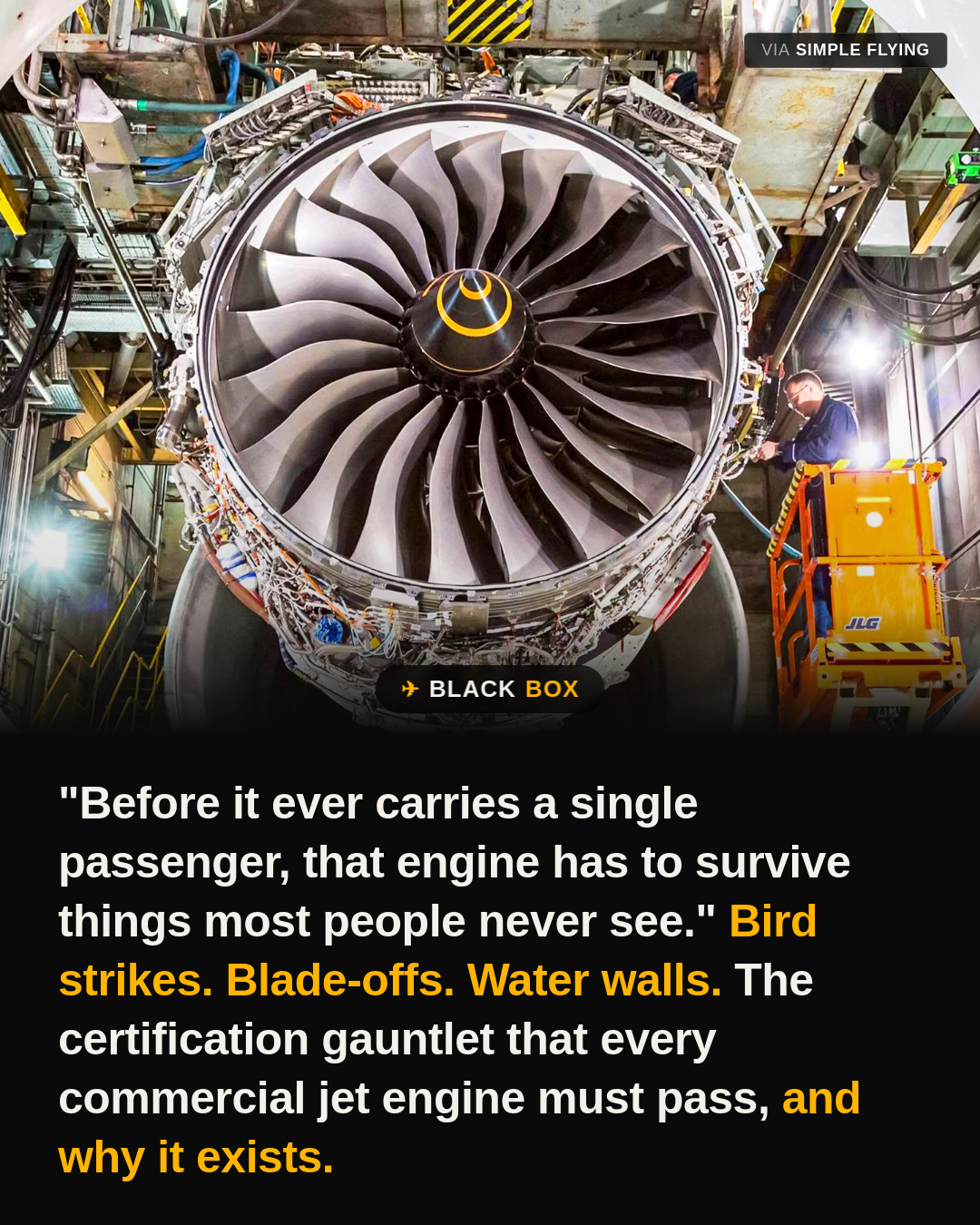
"Before it ever carries a single passenger, that engine has to survive things most people never see."
That's not a line from a thriller. It's the quiet reality behind every commercial turbofan sitting under a wing at your departure gate.
Before an engine is cleared to power a revenue flight, it goes through a certification process so demanding that parts are deliberately pushed until they break, on purpose, under controlled conditions, with engineers watching every millisecond of data.
In the United States, the Federal Aviation Administration sets the rulebook under a regulation called 14 CFR Part 33. In Europe, the European Union Aviation Safety Agency runs an equivalent framework known as CS-E. Different regulators, same core demand: prove the engine doesn't just run well, prove it fails safely.
That distinction matters. Engineers aren't only asking 'will this engine work?' They're asking 'when something goes catastrophically wrong inside this engine, does the damage stay inside the engine?' A turbine blade spinning at thousands of revolutions per minute carries enormous energy. If one detaches, a so-called blade-off event, that fragment cannot be allowed to exit the casing and enter the fuselage or fuel system.
So regulators require manufacturers to actually trigger that failure in a test cell and prove the casing contains it.
Bird ingestion tests fire real carcasses into running engines at speed, simulating what happens during a wildlife strike on approach or climb-out. Water ingestion tests flood the intake to replicate standing water on a runway during a heavy rain takeoff roll. Each test has a pass/fail threshold. There is no partial credit.
The engines that make it through are the ones you never think about. Which is, of course, exactly the point.
What surprises you most about how much goes into certifying an engine before it ever sees a passenger? Drop it below.