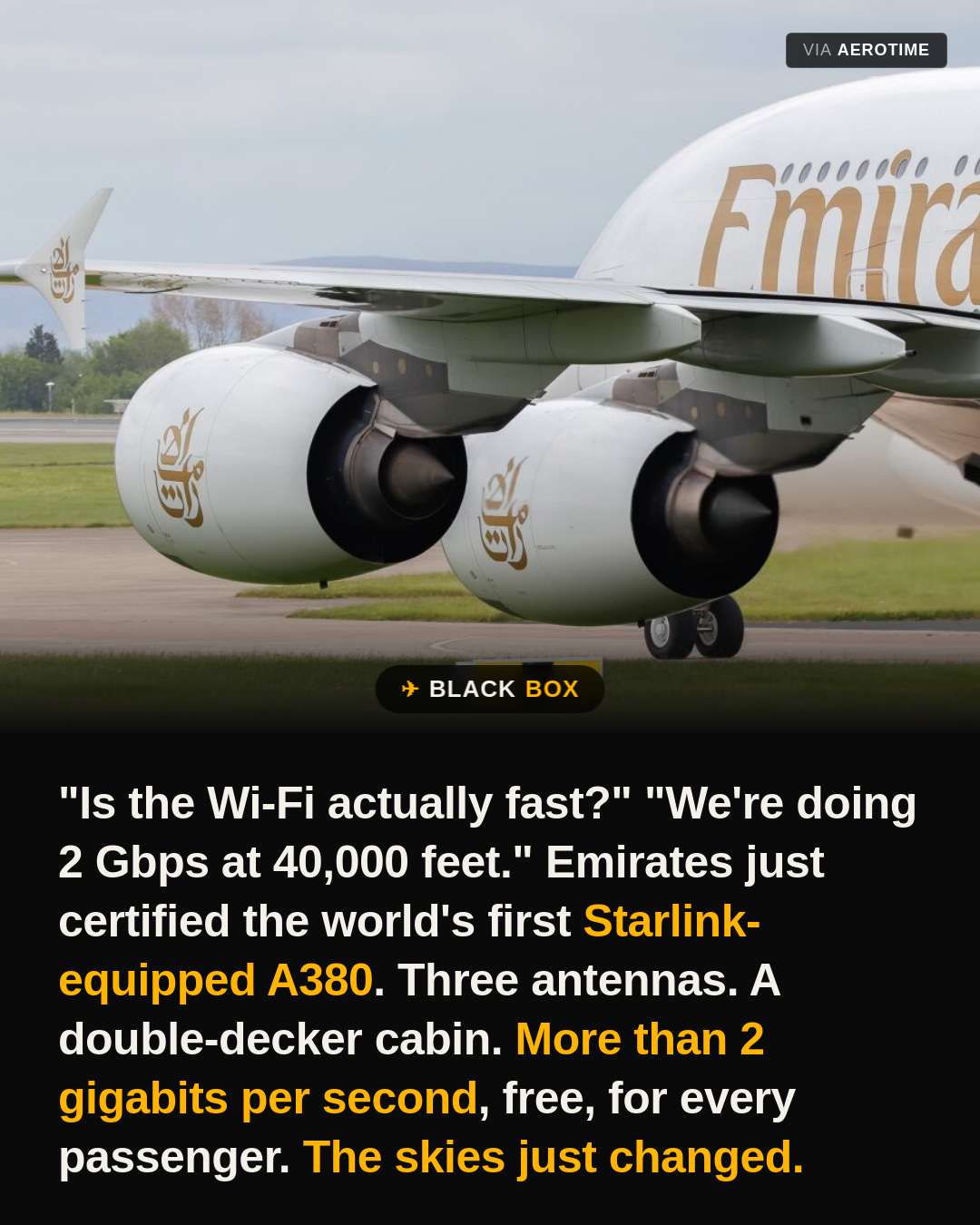
"Is the Wi-Fi actually fast up here?" "We're pushing over 2 gigabits per second. At cruising altitude."
That exchange might sound unlikely at 41,000 feet, but Emirates is making it a reality.
On April 24, 2026, the first Starlink-fitted A380, registered A6-EEA, touched down in Dubai after completing its installation and airworthiness certification in the United Kingdom. Three days later, Emirates confirmed what the aviation world had been watching: the iconic double-decker would soon offer passengers free, high-speed satellite internet as a standard feature.
The engineering side is worth pausing on. Starlink works through a network of low-Earth orbit satellites, satellites that orbit close enough to the planet to dramatically cut the delay that plagued older in-flight systems. Traditional in-flight Wi-Fi routed signals through satellites parked roughly 35,000 kilometres above the equator. The round-trip time for each data packet, called latency, made video calls choppy and streaming frustrating. Starlink's satellites sit hundreds of times closer, which makes the connection feel closer to what you'd use at home.
The A380 presented a specific challenge. The aircraft carries up to 555 passengers across two full cabin decks. Emirates' Boeing 777, which already carries Starlink across 25 aircraft serving more than 650,000 passengers, needs two antennas to cover its single-aisle-and-widebody layout. The A380 requires three, one more antenna, additional wireless access points distributed through both decks, and a total bandwidth capacity exceeding 2 Gbps across the entire cabin at once.
Installations are set to continue at Emirates Engineering facilities in Dubai, with the airline targeting roughly 14 aircraft per month across both fleet types.
No confirmed date for the first revenue flight with the new system has been announced, but the aircraft is back on home soil and the clock is running.
Does in-flight Wi-Fi actually change how you travel, or is it just a feature on a spec sheet? Let us know below.